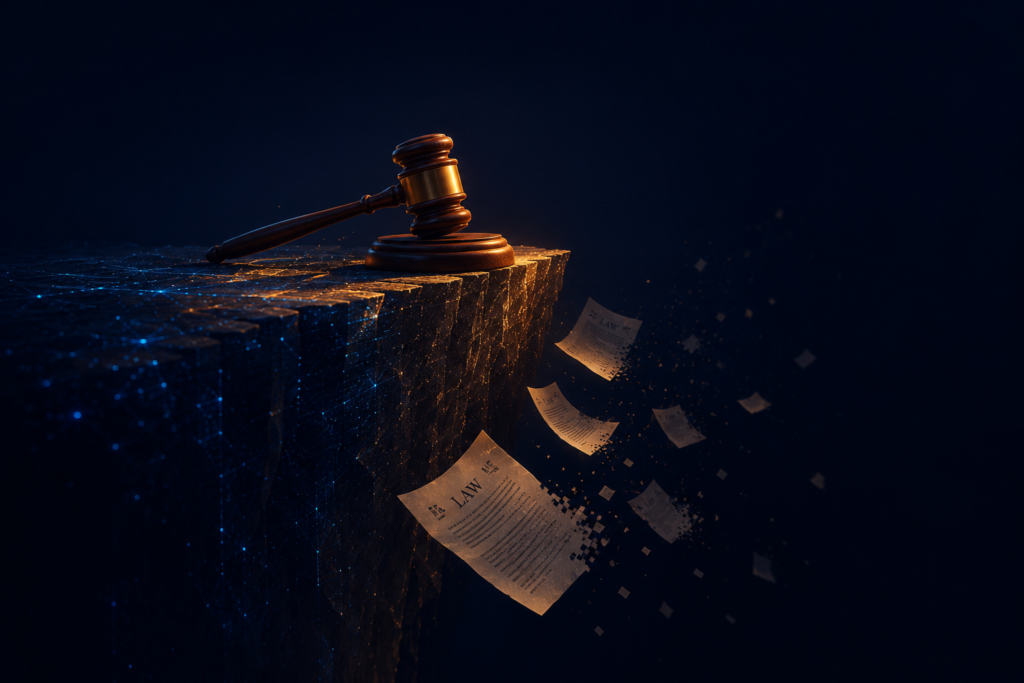
Well, the hammer finally dropped.
For the last three years, the generative AI industry has been playing a massive game of legal chicken. Companies scraped billions of images, articles, and lines of code to train their models, operating under the assumption that it fell under “fair use.” Meanwhile, creators and publishers kept firing off lawsuits, waiting for a judge to finally draw a line in the sand.
In the summer of 2026, the line was drawn. And if you are a business using AI to generate marketing materials, code, or commercial art, you need to pay very close attention to generative AI legal issues right now.
Here at The AI Prism, we don’t do legalese. We’re going to break down exactly what the recent landmark court decisions mean for you, why the “wild west” era of AI is officially over, and how to keep your company out of the crosshairs.
The “Copyright Cliff” Explained
Over the last eight weeks, a series of appellate court rulings have effectively created what legal experts are calling the “Copyright Cliff.”
The core issue was never really about whether a human can type a prompt and own the resulting image. The courts actually settled that early on: purely AI-generated works cannot be copyrighted because they lack human authorship.
No, the recent cliffhanger was about the input. Specifically, whether tech companies could legally use copyrighted material to train their commercial models without licensing it.
The 2026 ruling came down hard: Commercial AI models trained on copyrighted works without explicit licensing agreements are infringing on the original creators’ rights. The “fair use” defense was thoroughly rejected for commercial applications.
The Court Cases That Changed Everything
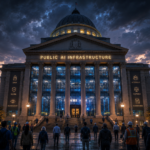
To understand where we are, it helps to look at the three cases that created the Copyright Cliff. The first and most consequential is The New York Times Company v. OpenAI, Inc., which reached the Second Circuit Court of Appeals in April 2026. The NYT’s argument was straightforward: OpenAI ingested millions of copyrighted articles to train its models, then built a commercial product that could reproduce those articles verbatim or generate summaries that competed directly with the original content. The court sided decisively with the NYT, ruling that commercial training on copyrighted material without a license constitutes “massive copyright infringement” that cannot be shielded by fair use. The case has been remanded for damages determination, and estimates range from $15 billion to $65 billion in potential liability.
The second pivotal ruling came in Andersen v. Stability AI, which consolidated cases from visual artists against multiple AI image generators. The Ninth Circuit ruled in May 2026 that while individual training images may not be directly infringing, the ability of these models to reproduce copyrighted works in “substantially similar” form on demand creates derivative liability. The court established a “market substitution test”: if a prompt can reliably generate images in a specific artist’s style, and a consumer uses that instead of commissioning the artist, the model has become a market substitute for the original work. This was a devastating blow to the “transformative use” defense that AI companies had relied on.
The third case, Getty Images v. Stability AI in the UK, actually set a precedent before the US rulings. The UK High Court ruled in February 2026 that AI training on copyrighted images without a license violates UK copyright law, establishing a global benchmark. The ruling was notable for its pragmatic remedy: rather than ordering the destruction of the model (which legal scholars argued would be impractical and disproportionate), the court ordered a compulsory licensing scheme with ongoing royalty payments tied to model revenue. This hybrid approach — finding infringement but crafting a remedy that doesn’t destroy the technology — has been widely praised as a model for balanced AI copyright regulation.
The Earthquake in Silicon Valley
This ruling sent immediate shockwaves through the tech industry.
The big AI labs are currently scrambling. We are seeing the immediate rollout of “provenance filters”—tools built into platforms that can mathematically prove a model was trained exclusively on public domain, licensed, or synthetically generated data.
But the bigger problem is the models already out in the wild. If your company has been using a model trained on unlicensed data to generate commercial assets, are you liable?
Here is the good news: The courts have generally shielded end-users from the training liability, placing that burden on the AI providers. If you used a popular AI tool to write a blog post in 2024, the original author isn’t going to sue you for copyright infringement.
But that brings us to the bad news.
The Licensing Framework Revolution
In response to the rulings, the industry has been racing to build licensing infrastructure that didn’t exist before. The most significant development is the “Content Registry” system being deployed by the Copyright Office in partnership with major platforms. Starting in August 2026, AI training companies must register their training datasets with the Content Registry, which cross-references each work against a database of rights-holder information. If a copyrighted work is identified in a registered training set without a matching license, the system automatically generates a licensing demand and, if unresolved, escalates to the Copyright Office for enforcement.
On the private side, companies like Shutterstock and Adobe have turned their existing licensing marketplaces into something far more ambitious. The “Shutterstock AI Training License,” launched in January 2026, allows any contributor to opt their entire portfolio into AI training for a per-image fee based on model revenue. Within six months, over 1.2 million contributors have enrolled, and Shutterstock has licensed its catalog to three of the five major AI labs. Adobe’s equivalent program, integrated into the Adobe Stock platform, has been even more successful, with over 85% of contributing artists opting in — likely because Adobe made the opt-in the default and tied it to generative AI tools that creators are already using.
Getty Images has taken a different approach, launching “Verify & License” — a tool that allows any creator to check whether their work appears in a major AI training dataset and, if so, automatically negotiate a license. The tool has processed over 500,000 claims in its first three months, with an average payout of $0.003 per training image per model version. While that number sounds vanishingly small, the scale is enormous: a photographer whose 10,000 images were used across four major model versions stands to receive approximately $120,000 in cumulative licensing fees.
Can You Protect Your AI-Assisted Work?
This is where 99% of businesses are getting tripped up with AI copyright laws in 2026.
Let’s say you use an AI tool to generate the first draft of a white paper, and then your human editor heavily revises it. Can you copyright that final white paper?
The current legal standard requires “substantial human transformation.” A few prompt tweaks and light copyediting are no longer enough. If the core structure, ideas, and phrasing originated from the AI, the courts are viewing it as uncopyrightable material.
This is a massive problem for brands. If you generate an AI mascot for your marketing campaign, you don’t own it. Which means a competitor can legally take that exact same mascot and use it for their own campaign, and you have no legal recourse.
The International Dimension: A Fragmented Global Landscape
One of the most challenging aspects of the new AI copyright regime is its fragmentation across jurisdictions. The United States, the European Union, China, and the United Kingdom have all arrived at meaningfully different legal frameworks, creating a compliance nightmare for any company operating internationally.
The European Union’s approach, codified in the AI Act’s copyright provisions that took full effect in March 2026, is the most creator-friendly. The EU requires that all AI training data be documented in a machine-readable format and that rights-holders can opt out of training for any purpose — including research. The “opt-out” mechanism is enforced through the “ROD” (Rights Objections Database), a centralized registry maintained by the EU Intellectual Property Office where creators can register their works. AI companies are legally required to check the ROD before every training run, and failure to do so carries penalties of up to 6% of global revenue.
China has taken the opposite approach, enshrining a broad “innovation exception” in its 2025 AI regulations. Chinese law permits AI training on any publicly available data, including copyrighted works, as long as the training does not “substantially impair” the original work’s market value. The standard is vague, but in practice, it has created permissive environment where Chinese AI companies have accelerated their model development while their Western counterparts navigate the new licensing landscape. This asymmetry is creating genuine concern among Western policymakers about competitive disadvantage, and there are already calls for a “level playing field” provision in future legislation.
Your 2026 AI Compliance Checklist
So, how do you keep your business productive without stepping on a legal landmine? You need to pivot your AI strategy from “generation” to “augmentation.”
Here is a quick compliance checklist to keep your legal team happy:
1. Demand Provenance for Commercial Use. Stop using open-source or unverified models for anything that goes on your website, in your ads, or in your products. Only use AI platforms that provide a “License Clean” certification, guaranteeing their training data is fully licensed.
2. The 80/20 Rule of Human Authorship. If you are creating something you need to own the copyright to (like a logo, a core software feature, or a flagship piece of content), AI should make up no more than 20% of the final work. Use AI to brainstorm, outline, or overcome writer’s block. But the heavy lifting of creation must be done by a human.
3. Update Your Terms of Service. If your platform allows users to upload or generate content using AI, you need to update your TOS immediately. Make it clear that users are responsible for ensuring the AI-generated content they bring onto your platform doesn’t infringe on third-party rights.
4. Audit Your Historical Assets. Don’t wait for a cease-and-desist letter. Do an audit of your digital assets from 2023–2025. If you have heavily AI-generated content currently being used in commercial ways, start budgeting to replace it with human-created or properly licensed alternatives.
5. Monitor International Obligations. If you operate in the EU, ensure your AI tools comply with the ROD opt-out database requirements. If you’re sourcing AI services from China, verify that the output does not infringe on US or EU copyright standards, even if it complies with Chinese law.
The Silver Lining for Creators
While businesses are scrambling to adapt, there is a massive silver lining here for human creators.
The Copyright Cliff has inadvertently created a premium market for human-made art and writing. As the internet gets flooded with uncopyrightable, generic AI slop, companies are realizing that if they want to own their intellectual property, they have to hire humans.
We are seeing a boom in freelance writers, illustrators, and composers who are explicitly marketing “100% Human-Made, Copyright-Protected” work.
The Bottom Line
The days of throwing caution to the wind and generating whatever you want with AI are over. The courts have spoken, and the era of AI copyright laws has officially matured.
Generative AI is no longer a legal gray area where you can ask for forgiveness rather than permission. It is a powerful tool that must be wielded with a clear understanding of intellectual property boundaries.
If your AI strategy doesn’t include a legal strategy, you’re doing it wrong.
1 thought on “The Copyright Cliff: What the Latest Rulings Mean for AI-Generated Content”
Comments are closed.