Do you know where your data goes when you ask your phone to summarize a confidential email?
A year ago, the answer was simple: it left your device, traveled through a cell tower, bounced to a massive data center in Virginia or Texas, was processed by a 200-billion-parameter model, and then the answer was beamed back to you.
Today, if you’re using one of the latest smartphones, that round trip doesn’t happen anymore. The computation is happening right in your pocket.
The shift to on-device AI has been the most underrated tech transition of 2026. While the tech press has been obsessing over massive data centers and energy grids, mobile engineers quietly figured out how to shrink 15-billion-parameter models so they can run comfortably on the chips already sitting inside our pockets.
And frankly? It’s about time. Here at The AI Prism, we’ve been advocating for localized processing for years. Let’s break down why moving AI from the cloud to your pocket is the best thing that has happened to consumer tech in a decade.
The End of the “Spinning Wheel”
The most obvious benefit of edge AI models is speed.
We got so used to the “spinning wheel of waiting” that we didn’t even realize we were tolerating it. Cloud-based AI has a latency floor. Even on a perfect 5G connection, sending a prompt, waiting for the server to process it, and downloading the stream takes a few seconds.
When you run AI locally, that latency drops to practically zero.
Need to remove a photobomber from the background of your vacation picture? The phone’s Neural Processing Unit (NPU) handles it instantly. Want to transcribe a 40-minute voice memo while sitting on a flight with no Wi-Fi? The phone does it offline in seconds.
We’ve moved from an era of requesting information to an era of instantaneous local compute.
The Silicon Showdown: NPU Benchmarks Across the Flagships
The on-device AI revolution would be impossible without the hardware to support it, and 2026 has been the year of the NPU arms race. Every major mobile chipmaker has dramatically increased the dedicated AI processing capacity of their latest silicon, and the numbers are genuinely impressive.
Apple’s A19 Bionic chip, powering the iPhone 18 Pro, features a 48-core Neural Engine capable of 75 trillion operations per second (TOPS). That’s more than triple the 17 TOPS of the A14 Bionic from just five years ago. The practical impact is that the iPhone can now run a 15-billion-parameter language model (equivalent to the original GPT-3 scale) entirely on-device, hitting 40 tokens per second — faster than most cloud-based models for casual use. The key engineering achievement is that Apple achieved this while keeping peak NPU power draw under 4 watts, meaning heavy AI use depletes the battery only slightly faster than streaming video.
Qualcomm’s Snapdragon 8 Gen 4, found in the latest Samsung Galaxy S26 and OnePlus 13, is even more aggressive on paper. Its updated Hexagon NPU delivers 52 TOPS, but Qualcomm’s key differentiator is memory bandwidth: the chip uses 10.7 Gbps LPDDR6 memory, providing the 128 GB/s bandwidth that large models need to run smoothly. Qualcomm has also invested heavily in its “AI Engine” software stack, which includes runtime model compression that can dynamically reduce a 7-billion-parameter model to 4-bit precision on-the-fly, cutting memory requirements by 75% with minimal quality loss.
Google’s Tensor G6, powering the Pixel 11, takes a different approach. Rather than maximizing raw TOPS, Google has focused on specialized hardware blocks for specific AI workloads: a dedicated speech recognition accelerator, an on-device diffusion model engine for image generation, and a custom “Gemini Nano” co-processor that handles the first pass of all AI requests before escalating to the cloud if needed. This specialization means the Pixel can perform specific tasks — like real-time translation, voice transcription, and photo editing — with significantly better power efficiency than the general-purpose NPUs in competing chips.
The Real Game Changer: On-Device AI Privacy
But speed is just a party trick. The real reason on-device AI is taking over in 2026 is privacy.
For the past three years, enterprise compliance officers have been having nightly panic attacks over generative AI. Companies were banning employees from using AI tools because there was no guarantee that proprietary code, financial documents, or sensitive client data wouldn’t end up in a training dataset or be exposed in a server breach.
On-device AI privacy completely flips the script.
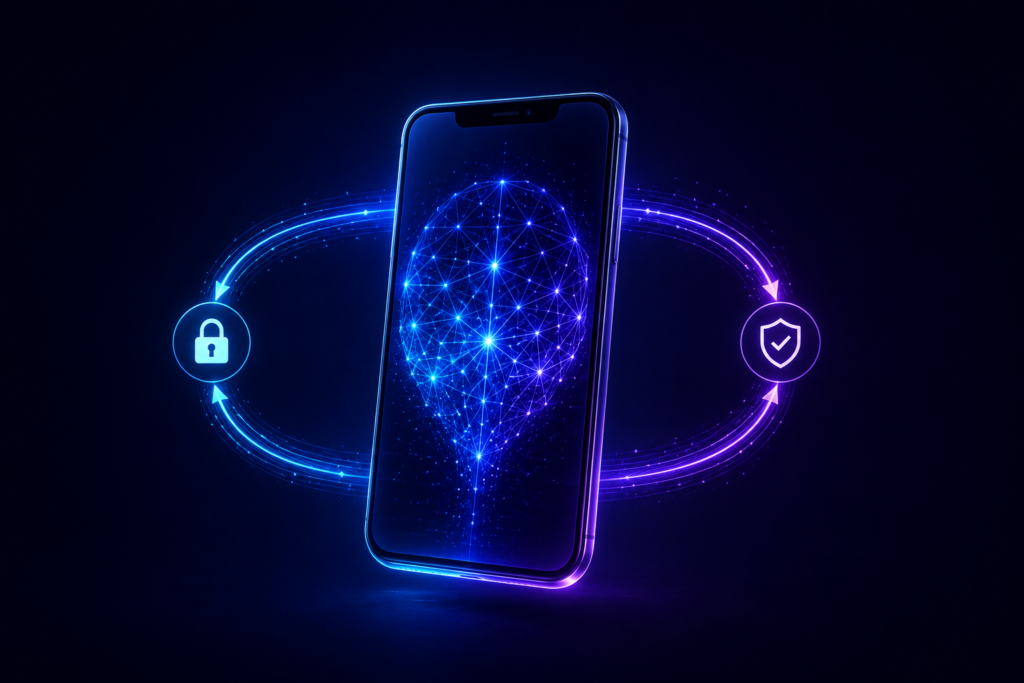
When your data doesn’t leave your phone, it can’t be intercepted. It isn’t stored on a third-party server. It isn’t used to train the next generation of someone else’s model.
This has unlocked a massive wave of enterprise adoption. Your phone’s operating system can now read your emails, analyze your calendar, and understand your location patterns to proactively suggest actions—all without sending a single byte of personal data to the cloud.
Your phone finally knows you, but it isn’t telling anyone else.
Models That Fit in Your Pocket: The Small Language Model Revolution
Hardware is only half the equation. The other half is the software side: the models themselves had to get dramatically smaller without sacrificing capability. That’s where the Small Language Model (SLM) revolution comes in.
Microsoft’s Phi-3 series, which started at 3.8 billion parameters and has now evolved into the Phi-4 at 14 billion parameters, was designed from the ground up for on-device deployment. The secret is “curriculum learning” — instead of training on the entire internet, Microsoft trains Phi on a carefully curated dataset of textbooks, code quality filtered by execution tests, and synthetic reasoning chains. The result is a model that, at 14 billion parameters, matches the performance of a naively trained 70-billion-parameter model on reasoning benchmarks, while consuming less than a fifth of the memory.
Apple’s OpenELM models, released in April 2025 and updated through 2026, take a different optimization approach. Apple uses “structured pruning” to remove redundant neurons from a larger base model, combined with “post-training quantization” that reduces each weight from 16 bits to 4 bits. The 8-billion-parameter OpenELM-2 model, running on iPhone 18, achieves scores within 5% of GPT-4 on the MMLU benchmark while requiring only 4.5 GB of RAM and drawing 2.3 watts during inference. That’s efficient enough to run in the background while you use other apps.
Google’s Gemma 3 series, released in March 2026, includes a 2-billion-parameter model specifically optimized for the Pixel’s Tensor G6. Google’s innovation is “speculative decoding” — a technique where a tiny draft model (270 million parameters) generates candidate tokens extremely quickly, and a larger verification model checks them in parallel. Because the draft model handles 80% of the computation for simple tokens, the effective speed of the 2B model running on-device is approximately 100 tokens per second — fast enough for real-time voice conversations with no perceptible delay.
The Enterprise Use Case: Why Compliance Teams Love On-Device AI
The consumer benefits of on-device AI are obvious, but the enterprise story is where the real economic impact lies. In regulated industries — healthcare, finance, legal — sending data to cloud AI APIs has been effectively impossible due to compliance requirements. HIPAA in healthcare, GDPR in the EU, and FINRA rules in financial services all create barriers that cloud-based AI simply can’t clear.
JPMorgan Chase, one of the earliest enterprise adopters of on-device AI, deployed on-device language models to 40,000 traders and analysts in early 2026. The use case: real-time analysis of earnings call transcripts and regulatory filings, with the AI running entirely on the employee’s laptop. The bank reported that the deployment eliminated 2.3 million hours per year of manual document review, with zero data leaving the corporate network. JPMorgan’s CTO told a conference in March 2026 that “on-device AI was the only way we could deploy generative AI in a regulated environment. Cloud AI was simply not an option for us.”
Similarly, the UK’s National Health Service (NHS) has deployed on-device AI for clinical note summarization across 50 hospital trusts. The system runs on standard hospital tablets and summarizes doctor-patient conversations into structured clinical notes, all processed locally. The NHS estimates it saves clinicians an average of 45 minutes per day, equivalent to 1,500 additional clinical hours per week across the deployment. Because no patient data ever leaves the device, the system required no new data protection impact assessment, and deployment took 8 weeks from approval to go-live — compared to the 14 months the NHS estimates cloud-based equivalent would have required.
How Did We Fit a Supercomputer in Your Pocket?
You might be wondering how we went from needing warehouse-sized server farms to run ChatGPT, to running highly capable models on a device that fits in the palm of your hand.
Two words: Quantization and NPUs.
Quantization is a fancy math term for compression. Instead of using heavy 32-bit numbers for the AI’s neural network, developers figured out how to round down to 4-bit or even 2-bit numbers. This strips away a lot of the “fat” in the model without significantly impacting the quality of the output.
The second piece of the puzzle is hardware. Modern mobile processors now dedicate massive amounts of silicon to NPUs (Neural Processing Units). These chips are specifically designed to do the kind of heavy matrix math that AI requires, drawing a fraction of the battery power that a standard CPU would use.
Because of this, running local AI processing on your phone drains your battery about as much as playing a game of Candy Crush.
The Cloud Isn’t Dead Yet
Before you think the cloud is going the way of the dodo, let’s pump the brakes.
We are entering a hybrid era. Your phone will handle 90% of your daily AI tasks—voice dictation, photo editing, text summarization, and basic search. But when you need to do something incredibly complex, like generating a high-definition 3D model from a text prompt, your phone will quietly ping the cloud to do the heavy lifting.
Think of it like your brain. If someone asks you to calculate a 15% tip, you do it in your head. If someone asks you to calculate the trajectory of a rocket, you grab a supercomputer.
Your phone is now smart enough to know the difference.
The Bottom Line
For years, the tech industry operated on the assumption that bigger is always better. Bigger models, bigger servers, bigger clouds.
But 2026 has proven that smarter is better. By pushing AI capabilities to the edge, we’ve solved the three biggest problems facing the industry: latency, privacy, and offline accessibility.
If you haven’t explored what your current device can do offline, put it in airplane mode this weekend and try asking it to draft a tricky email or summarize a PDF. You might be shocked at how capable your pocket has become.






2 thoughts on “On-Device AI Has Quietly Taken Over Your Phone (And Why That’s a Good Thing)”
Comments are closed.