

Updated October 22, 2026. Synthetic data is produced by a model or simulation rather than collected directly as a new observation. It can supply useful training examples, but generated volume is not the same as new information, verified correctness or representative coverage.
Generation and verification are different jobs
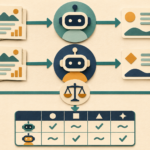
A model can produce many candidate examples. A separate process must decide which are suitable. For code, tests can catch some errors; for factual writing, fluent wording is not a factual check. The verifier’s weaknesses can become weaknesses in the resulting training set.
Consider generating support questions for a product. The output may cover common questions while repeating the same assumptions and omitting unusual failures. Compare the generated set with real, appropriately collected examples rather than assuming variety because the wording differs.
What model-collapse research shows
A 2024 Nature paper studied the degradation that can occur when generated material recursively becomes training data for later model generations. That result identifies a risk in the examined training conditions; it does not establish that every use of synthetic data must fail.
Research on accumulating real and synthetic data also examines how retaining original observations changes the outcome. The training recipe matters. Replacing a dataset, adding to it and selecting verified examples are different interventions.
A practical data-quality record
Record the generating model and version, the prompt or simulation settings, the selection rules and the source of any ground-truth checks. Keep evaluation data separate from generated training examples so a model cannot appear to improve simply by seeing close versions of the test.
Inspect coverage by task and by important edge cases. Remove duplicates, track rejected examples and compare results with a baseline that does not use the synthetic additions. These are suggested quality controls, not findings from a training run performed by The AI Prism.
Do not infer privacy from the word synthetic
Artificial records can still reproduce sensitive details or misleading patterns from their source material. Evaluate disclosure and representativeness separately. A dataset should not be described as anonymous or unbiased simply because a model generated it.
Claims about the share of synthetic tokens in frontier training need an identified source and a clear definition. This explainer makes no estimate of that share and does not claim that human knowledge or real-world observation has become unnecessary.
Sources and further reading
Editorial update: Removed unsupported training-token percentages, claims that human data ran out, and misleading descriptions of self-play and historical research. This is an AI-assisted explainer, not a report of hands-on testing.





1 thought on “Synthetic Training Data: When Generated Examples Help—and When They Mislead”
Comments are closed.