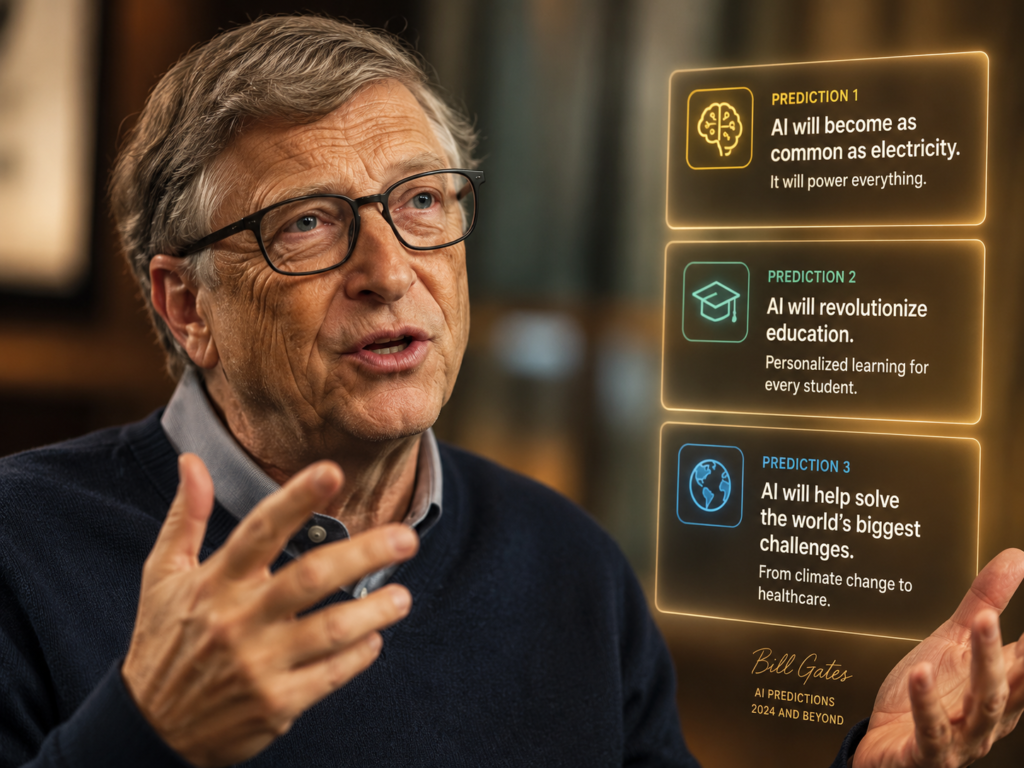
Updated October 25, 2026. Bill Gates’ January 9 essay, The Year Ahead 2026: Optimism with Footnotes, sets out an optimistic view of innovation alongside questions about who benefits and how disruption is managed. Its forecasts should be read as the author’s expectations, rather than evidence that the predicted outcomes have happened.
What the essay actually organizes around
Gates frames the discussion around generosity toward people in need, scaling innovations that improve equality, and managing harmful disruption from AI. He discusses climate adaptation, healthcare and education, as well as misuse and changes in employment. He also argues that AI capabilities will continue improving, using the phrase “no upper limit.” That is his forecast, not an established scientific ceiling or a timetable.
The healthcare section includes a qualification: developers still need to improve reliability and connect systems with clinicians who can check and override them. The essay also acknowledges uncertainty in modeling labor-market effects. Those cautions belong alongside the optimistic predictions.
Two attributions removed from this article
Our earlier version claimed the essay predicted an antibiotics-style breakthrough within three years and that small specialized models would have the largest impact. Those attributions are not supported by the cited essay and have been removed. Separate research about antibiotics or on-device models cannot establish that Gates made either statement in this source.
A reading framework for technology forecasts
| Type of statement | What a reader should request |
|---|---|
| A capability prediction | A defined task, evaluation conditions and evidence of performance. |
| A healthcare deployment claim | The actual setting, study design, oversight and measured outcomes. |
| A claim about wider access | Who can use the service, under what conditions and at what cost. |
| A labor-market conclusion | The population, period, measure and basis for a causal explanation. |
This table is our suggested editorial checklist. It does not score Gates’ predictions or report an independent product evaluation. It separates questions that can otherwise disappear inside a broad claim that a technology will change society.
A proposed project, a pilot and an achieved outcome should also receive different labels. A project announcement can establish an intention or commitment. Showing that people benefited requires further evidence. When reporting a later development, check its own dated source rather than treating it as confirmation of every earlier forecast.
What would make a follow-up useful?
Choose one prediction and define the observation that would support or weaken it. For a proposed service, that might mean documenting access and an appropriate outcome measure. For a workforce claim, it means distinguishing exposure to a technology from a measured change in employment and its cause.
Revisit that question with the new evidence and its limitations. Changing the wording of a forecast after the event makes it harder to assess. Keeping the original scope visible gives readers a clearer basis for judgment than a collection of success stories chosen afterward.
For a worked example of that distinction, read our explanation of California’s AI-unemployment tracker.
Primary source: Bill Gates, The Year Ahead 2026: Optimism with Footnotes, January 9, 2026.
Correction, October 25, 2026: Removed unsupported predictions attributed to the cited essay, invented first-person reactions and unsupported claims about personal financial exposure. Revised the headline and summary. This is AI-assisted source analysis, not an interview or independent test.