
Catch-up edition for the October 26 editorial slot. First published November 2, 2026.
A convincing AI answer can fall apart one click later. The link exists, the paper is real, and the sentence still says more than the source supports. Checking only whether a citation opens catches broken references; it does not catch a conclusion attached to the wrong evidence.
Use a smaller unit of review: one claim, one supporting passage, one decision. The worksheet below is designed for an ordinary article or workplace summary. It is an editorial method, not a measured guarantee that an answer is correct.
Start with the sentence you might repeat
Copy the exact factual sentence into a note. Keep its numbers, dates and qualifiers. “The tool reduced handling time in this study” is a different claim from “AI makes everyone more productive.” If you shorten the sentence before checking it, you can accidentally remove the very limitation that matters.
For a paragraph with three claims, make three rows. A single reference at the end of the paragraph should not be treated as support for everything before it.
Check identity before interpretation
Open the source through its publisher, research repository or official organization. Compare the title, author, publication date and document identifier with the answer. A real identifier can belong to an unrelated paper. A news story can also describe a report that changed after the story appeared.
NIST’s Generative AI Profile identifies confidently presented false content, including fabricated supporting material, as a risk. That is a reason to inspect the evidence; it does not supply an error rate for whichever assistant you happen to use.
Find the passage that does the work
Search the document for the distinctive number or phrase. Then read the surrounding section, including any relevant table notes. Ask what was measured, who or what was included, and what comparison was made. An abstract can describe the broad finding while a methods section explains why it should not be generalized.
| Check | Record |
|---|---|
| Claim | The exact sentence under review |
| Source identity | Title, author or organization, date and stable link |
| Evidence location | Section, page or table and a short note in your own words |
| Scope | Population, task, period and comparison |
| Decision | Supported, needs qualification, contradicted or unresolved |
A worked example: a percentage without a denominator
Suppose an imaginary report says 18 of 60 participating teams completed a particular task. An assistant writes, “Only 30% of companies can use the technology successfully.” The arithmetic is right: 18 divided by 60 is 30%. The sentence is still unsupported. Participating teams are not all companies, completing one task is not the same as using a technology successfully, and “only” adds an interpretation.
A defensible sentence would describe those 60 teams and that task. If the sample was selected in a way that limits comparison, preserve that limitation too. This example is hypothetical; it is not a claim about a real survey.
Use an unresolved category
If a paywall, missing appendix or inaccessible dataset prevents checking the key claim, write “unresolved.” Do not turn a plausible summary into a verified fact. You can omit the sentence, qualify what you have actually seen, or seek another source with independent evidence. Ten articles repeating the same announcement are not necessarily ten independent confirmations.
For decisions with meaningful consequences, route the material to someone qualified to assess the underlying subject. A citation worksheet cannot replace specialist judgment.
Keep the correction with the claim
Save the checked wording alongside the link, not just in a browser bookmark. If you later change “may” to “will,” check the claim again. If the source is corrected or updated, record which version you used.
When the answer came from an agent using external documents, also review how document instructions can cross a trust boundary. For repeated workflows, add evidence checks to the agent evaluation scorecard. The useful result is a claim you can explain and defend, rather than a page covered in links.
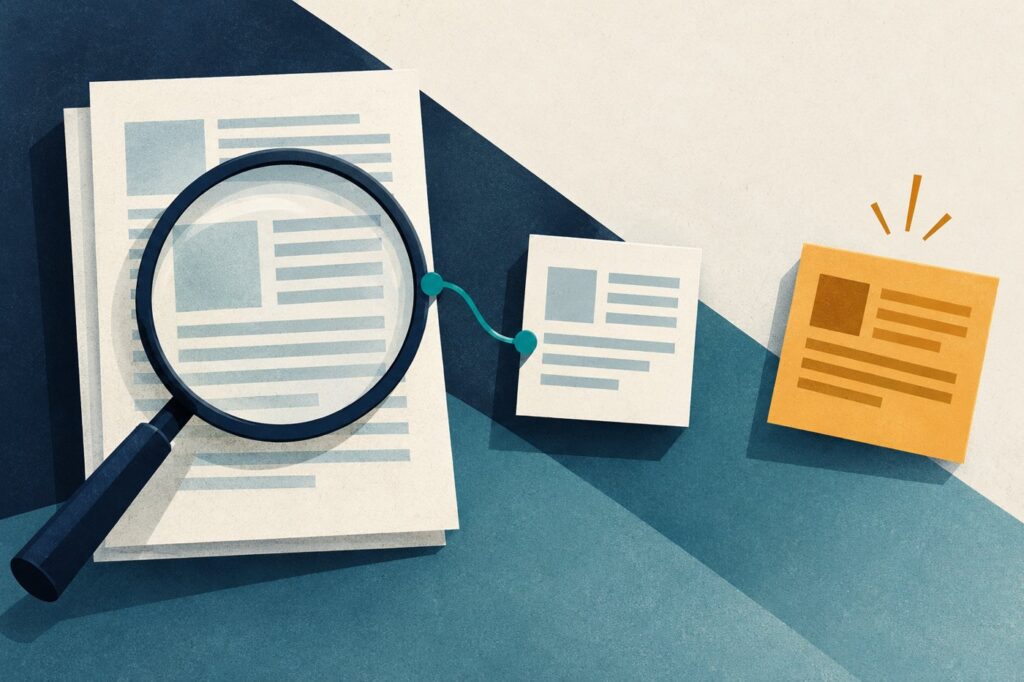
Editorial illustration: AI-generated conceptual artwork, not a screenshot of a research tool.