
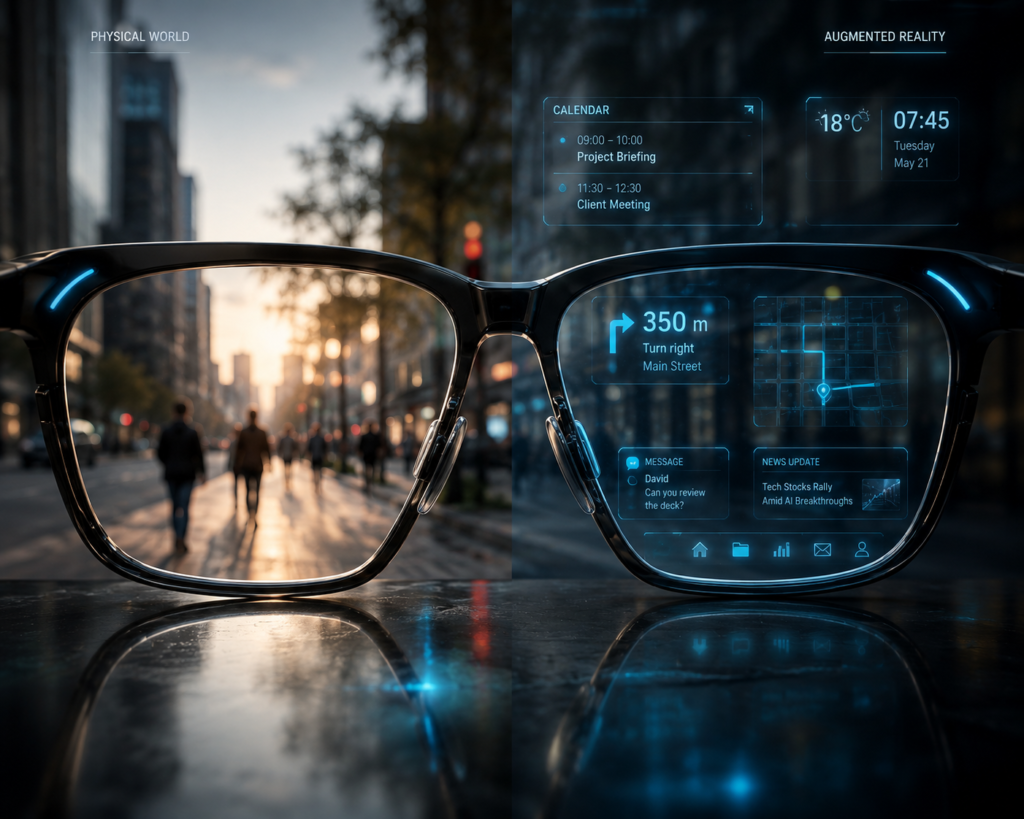
Updated October 22, 2026. A camera-equipped assistant, glasses with a display, and a headset that overlays spatial content offer different experiences. Treating all three as the same product makes it difficult to judge what someone can actually buy and use.
Separate the product from the prototype
Meta introduced Orion in September 2024 as an augmented-reality prototype for employees and selected external audiences. That announcement is evidence of a development program, not a general consumer review or a promise that every demonstrated feature is available in a retail product.
When reading a newer announcement, check its date, whether the device is shipping, the supported countries and languages, and which functions require a phone or cloud service. This article does not maintain a current price list or claim hands-on access to the devices.
Match the device to a task
For reading a short message, display legibility and notification controls may matter most. For identifying an object, camera framing and the ability to verify an answer become important. For navigation, ask what happens when location or connectivity is poor.
Write down one task you would use repeatedly. Then check how many interactions it takes, what information is visible, and whether you can complete the task without exposing more information than intended. A demo assembled around ideal lighting and a prepared scene cannot answer every everyday-use question.
Questions a review should answer
Does the review identify the exact model and software version? Does it distinguish advertised battery life from measured runtime? Are failures and connectivity requirements described? Are photographs and screenshots actual device captures or illustrative images?
Comfort, prescription compatibility and accessibility are personal considerations. Camera and microphone use can also affect people nearby. Look for understandable recording indicators, deletion controls and settings that fit the places where you intend to use the device.
A useful buying decision
An assistant that works well for a bounded task can be useful without replacing a phone or computer. Compare it with an existing option on time, effort, reliability and total cost. Keep any conclusion limited to the tested product and conditions; the entire category cannot be declared successful from a single demonstration.
Sources and further reading
Editorial update: Replaced broad claims about universal AR adoption and unverified product capabilities with a clearly scoped evaluation guide. This is an AI-assisted explainer, not a report of hands-on testing.