
Opening an AI assistant is an adoption event. Completing useful work with less total effort is a productivity result. Counting the first does not measure the second, and a finding from one occupation cannot establish what happens in every workplace.
The earlier version of this article described AI adoption as nearly universal and suggested that gains had not appeared. Those claims were too broad. Published evidence includes benefits in some settings, slowdowns in others and important limits on what current studies can measure.
Three pieces of evidence to keep in their own settings
Brynjolfsson, Li and Raymond’s Generative AI at Work working-paper abstract reports a 14% average increase in issues resolved per hour among 5,179 customer-support agents given access to an assistant, with larger gains among less experienced workers. That outcome concerns the studied support workflow, not all work.
METR’s early-2025 developer experiment found that participating experienced open-source developers took 19% longer on their tasks when AI tools were allowed. METR explicitly cautions against treating that result as representative of most software development.
There is also a relevant follow-up: in its February 24, 2026 methodology update, METR explains that selection effects and time-measurement difficulties made its later experiment an unreliable signal of the current productivity effect. It describes its later data as weak evidence about the size of a change. Omitting that update would leave readers with an incomplete picture.
These results need not contradict one another. The workers, tools, tasks, dates and outcome measures differ. A careful comparison keeps those differences visible instead of turning either result into a universal answer.
Measure the whole task, including review and repair
Consider a hypothetical report that normally takes 120 minutes. With an assistant, the initial draft takes 70 minutes, checking takes 35 and repairing errors takes 20. The total is 125 minutes. The draft was faster, but the complete accepted result took five minutes longer.
Now imagine the same 70-minute draft needs only 15 minutes of checking and five of repair. Total effort is 90 minutes. Against the same 120-minute baseline, that is 25% less elapsed effort. Both examples are arithmetic illustrations; neither is a measurement made on an actual AI product.
| Record | Keep consistent between conditions |
|---|---|
| Task and inputs | The same difficulty, source material and permitted tools |
| Acceptance criteria | What counts as a correct, usable final result |
| Total effort | Preparation, prompting, waiting, checking and repairs |
| Quality failures | Unsupported facts, omissions and unusable output |
| Intervention | Help or corrections supplied by a person |
| Configuration | Model or software version, date and settings |
Design a small comparison before expanding a workflow
Choose several representative tasks rather than a single demonstration. Define how you will judge the final result before seeing it. Avoid giving one condition easier examples. If the same person repeats a task, record the possibility that familiarity changes performance.
Keep failed and abandoned attempts in the record. Otherwise the comparison can make a system look efficient simply by counting only the cases where it worked. Separate the amount of accepted work from the amount of text, code or slides generated.
A small comparison can identify a local problem worth fixing. It cannot establish a national productivity growth rate or predict the effect of every future model. For a multi-step assistant, use our interactive evaluation record alongside your timing notes so a faster result does not conceal a permission or evidence failure.
Updated October 26, 2026: removed unsupported adoption and economy-wide conclusions, distinguished the research settings and added METR’s 2026 methodological follow-up. AI-assisted analysis; examples are hypothetical, not an original workplace study.
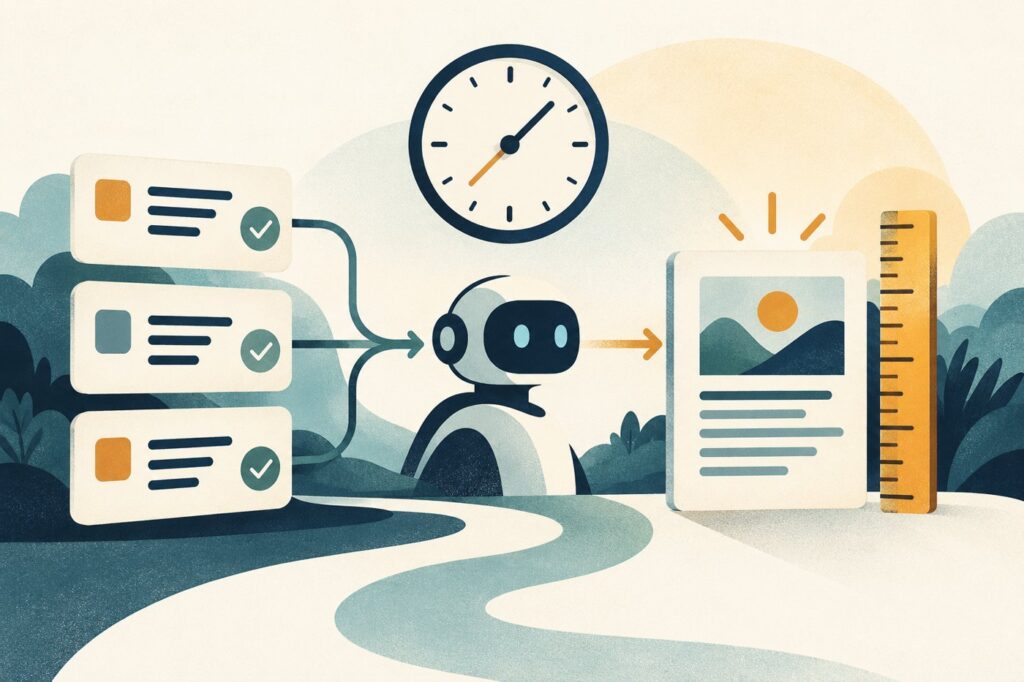
Featured image: AI-generated editorial illustration, not measured productivity data.





1 thought on “AI Productivity: Measure the Whole Task, Including Review and Repair”